The Clothesline.
Short Story #1: When Sight Becomes A Tale.

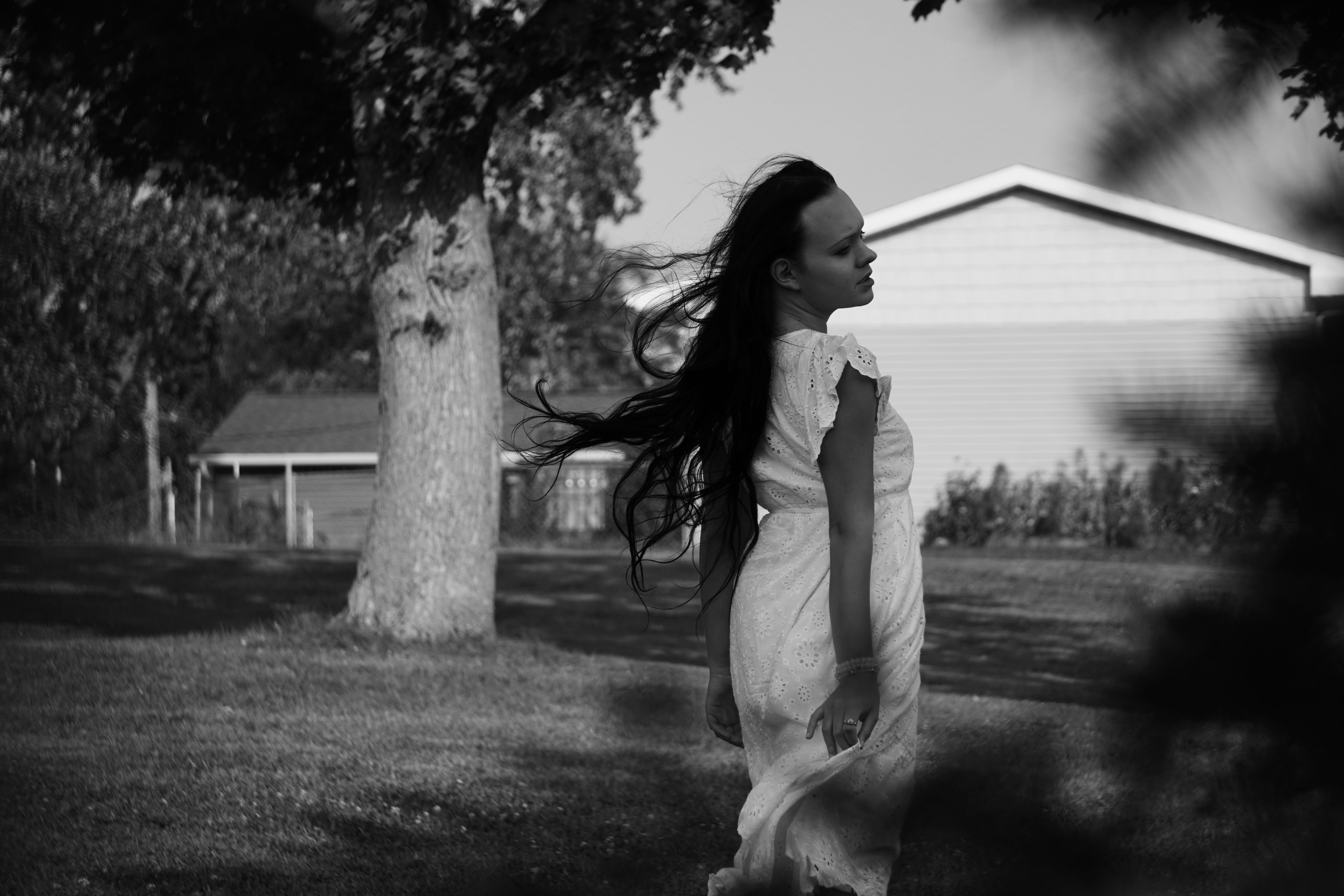
Rubbing her fingers on the bristles of the surface always induced a tingle down her spine–a warm, fizzy tingle. Yet, she dreaded the sensation just before, that feeling of skin pulling back skin, or what she imagined was grazing inverted skin–fibrous and skin-crawling. Even her mother hated the feeling, and yet her mother always dressed her in violet velvets, the color of lavender detergent.
The clothes rustled in the fine wind underneath the scorching sun–a town of violent suns and few sunless moments. All she knew was sun. She wondered what the texture of the sun felt like, the bristles of the sun’s pulp–if there were any bristles?
“Lima!” she heard her mother calling from inside the house as she stood meditating on the clothes rustling in the violent winds–rustling like leaves, like moving monuments she could feast her eyes upon without needing to acquire the means to do so.
“Lima, get inside!” she said again, but this time–as if time broke–her mother was already towering there by the clothesline. How long was I…? Dazed, she was at once startled and obedient.
Time bore Lima away to fine spaces, lush with promise. She became too affixed to the sensation of time warping; removed from it, she learned to row through her dreams like a canoe–the most charming canoe, carved entirely of sandalwood. Because one day she would have to move, she would no longer crawl out of her skin to cooperate with the systems of the world.
All things appeared to her as a Grant Wood canvas. Then a flash–the memory of first seeing the American Gothic. The gallery stood across from the Masonic Temple. Lima remembers in hues, the weight of the air, the way the sun slanted into the room at the precise moment she lived within the frame. She could never recall what followed. The moment stood solitary and stark, and for her, that was enough.
Glancing at American Gothic, she sought the source of her fascination. Her gaze remained fixed upon the woman–a figure of subtle weariness, though the realization eluded her then. In the distance, spherical trees stood stark against a sky that commanded the horizon, reducing the landscape to a mere periphery. Lima was captivated by the palette: the painting mirrored the very chroma of her own existence. Everything appeared vibrant, washed in a golden light that deepened the foliage to honey and turned the stark whites to ivory.
“Lima!” her mother would exclaim, gathering her from the exhibit. Lima could no longer recall what she had painted, or indeed if she had painted at all, but only the singular canvas that had monopolized her vision. Nor had the class at the exhibit been her own design; it was her mother who deemed it best to provide the wretched girl a hobby, rather than leave her to meditate on the laundry as it shivered in the dry winds.
“You know, Lima, if you so desire to stare at the laundry all day, why do you never bring in the clothes when they’re dry?” her mother said, with a slight despondency that only heightened her irritation. “Why am I always doing everything?!”
Lima dreamt of inhabiting the American Gothic–not to dwell as the subjects did, but to exist as the trees, in the precise hue of that canvas. Asked what she would be when she grew up, she would mumble: A hue?
She always wondered why her skin was white when it should have been green. Inquiring one night, she asked her mother why she wasn’t born green. Her mother sighed, a breath all too familiar with the customs of such ridiculous questions.
“I think you’ve been reading too much,” she said. “I named you Lima because all you wanted while you were inside my stomach was green foods–particularly steamed lima beans.”
Mother’s tolerance for questions was low, particularly those from Lima. A strange child–a burden, really, in the thinking of her own mother. Why couldn’t she be normal? Whatever normal was, why couldn’t she just be?
Lima remained strangely removed from her surroundings. Her mother, swearing she was immobile, decreed she be sent to a sanitarium to board out her days. But did she?
Lima was under her mother’s care only until she was sent to live with a family friend. Robert was a stoic man who spent afternoons polishing rims and building properties on the land for sport. He also had a clothesline, at which Lima would stare. What was she thinking? She was dreaming.
But why the clothesline? There was something so elemental about the way the sun cast upon it, and the way the laundry stained the trees a brighter shade of golden green. The marriage of colors and hues was her ecstasy–though she wouldn’t know to call it that.
Robert watched from a distance as Lima stared, arms slack at her sides, stoic before the clothesline. She stood centered and parallel to the wire, her frame as rigid as a tree, unyielding to the wind. She found a grim pleasure in this. Robert was terrified–a man who had faced the devil with ease, now unnerved by the girl’s quiet possession.
At dinner, Lima sat on the opposing side, Robert staring with an astounding horror as she picked at the strings of the chicken meat. Though she never vocalized her feelings, he found her, as did many others, intensely expressive.
Robert broke the silence. “You know, if you don’t like your food, you don’t have to eat it.” She mumbled an answer, still plucking the strings of chicken as if unweaving them. “I know.”
The mere idea of being ordered about did not phase her, knowing well she wouldn’t have to do it. When her mother commanded, Lima would act with such obedience that it derailed the very act, hijacking her mother into believing she had achieved her aim.
Robert was a man, an honorably quiet one, and as long as Lima didn’t ask for much, he saw it best to let her be. But one night he grew terrified–so terrified of Lima, without knowing why–that he knew he would have to put his foot down.
He would say, in a voice stern yet gentle–brash as gravel stuck in his throat–”I should make myself clear on the ground rules of boarding here.”
Lima would stare at him, just as she stared at the ceiling to lose count, acting as though she were listening. Robert believed it, for she was good at convincing without a single stroke of effort, yet all she heard was the sequence of her own musings playing on such a queue that she could hardly catch up.
A fresh wave of fear took hold of Robert. “God damn it, why don’t you blink?! You’re frightening me, child!”
He forced his tone lower, wearing an outward mask of regret for having lost his cool. But Lima just kept staring, entirely indifferent to whether or not she blinked. “Lima, I didn’t mean to yell…” He said it, breathing heavily, the prelude to another meltdown. She mumbled, on cue, “I know.”
Robert, finding himself at a loss, returned Lima to her mother. “Something is wrong with your child. I know not what, but something is seriously wrong, and it is taking a toll on my health and my work.”
Lima would hear them both bickering back and forth inside the old, closed-off porch, caged in by netting attached to the house. Her mother often let the tooth drag out faster than the tongue, coming on within a vengeance to make her wrath known–a calculated wrath she used to get her way. “How bout you go screw yourself!” her mother would holler at Robert, with the cups of her fuchsia bra stark against her white tank, as he slammed the door of his rusted blue Ford, backing onto the gravel roads with such haste.
What Lima remembered most was the hue–the stubborn persistence of color in a fading scene. The world had taken on the sepia grit of an old Western, a desert floor where gravel masqueraded as thick sand. When Robert drove off with a vengeance, his tires churning the gravel, the rising dust mimicked a violent sandstorm. She remembered her mother’s fuchsia bra, its pigment deepened under the gilded light, and the grass that stood like brittle stalks of golden wheat. And then, the clothesline–white, chipped, and possessed of a singular, ragged beauty.
“Lima! Look at what you’ve done! Now, what are we going to do with you?” A cigarette dangled from her mother’s lips, slight clouds of smoke appearing transparent within the golden light. All her concentration was fixed upon the clothesline–upon the lines stripped naked of clothes, yet enabling her to imagine them rustling in the wind. The winds were violent on this day.
“Lima! Answer me! What on God’s green earth are you staring at?”
Nothing surrounding her possessed enough potency to break that gaze. It was a deep immersion into the stark white of the clothesline–patches of banana yellow appearing, almost accusingly, beneath the flaking paint. A yellow line? No. That wouldn’t satisfy her. Yet all she saw were chips of paint peeling back to reveal the yellow that lay beneath the white.
Her mother kept yelling, her voice mixing in the wind–a broad imitation of an entire line of fabrics rustling so violently in the gusts, a tedious whirring and whipping, whipping and whirring. This satisfied Lima, making her forget the patches of yellow.
“Lima! I need you to answer me! her mother said, bursting into a fit of tears while holding onto her cigarette with the last vestige of her day. Because that was it–Lima would never be what anyone expected. Her obedience was strategic, never whole, a failure to follow the guidelines. She knew she would need to, but reckoned with an inability to follow rules, even the rules of herself–rules as sparse and subtle as remembering to breathe full breaths.
The way her mother’s scolding mixed in with the winds, with the clothes–not on the line, but heard inside her dreams–and how the anger induced a fine tingle, like brushing fingers against the bristles of velvet; skin upon skin.
And that was it! The sensation of grazing the surface of a moment with bristles. She felt this as she grazed her fingers over the crackling white paint of the clothesline–a feeling felt with her eyes first.
Everything that played out was attached to a hue she could only begin to fathom. The hue of things, it seemed, was all that mattered to Lima. While she never took the clothes from the line to carry them into the house, she would watch them rustling in the wind, loving it–loving it so entirely that she never needed to understand the nature of her love for such a sight.
Was it the hue, or the sight itself she loved? Would she have cherished the line on a day when clouds overlapped the sun? Yet, when would they? For every day was a sunny day, and every day through the looking glass of Lima’s eyes was one of golden pastures, of chipped white paint, of bristles velvety as a horse’s skin–the hues of the American Gothic painting. All that mattered were the hues of existence. What lay outside her dreams was a mere background of sky, existing only to frame her eternal gaze at the clothesline.
Beautifully written!
This piece is vivid and captivating.
Is this premium substack? What is this treasure I have stumbled upon ✨💕